TOKYO’26 . . . reflections
fragments 2 today we’ve met Einstein at Tokyu Toyoko Line

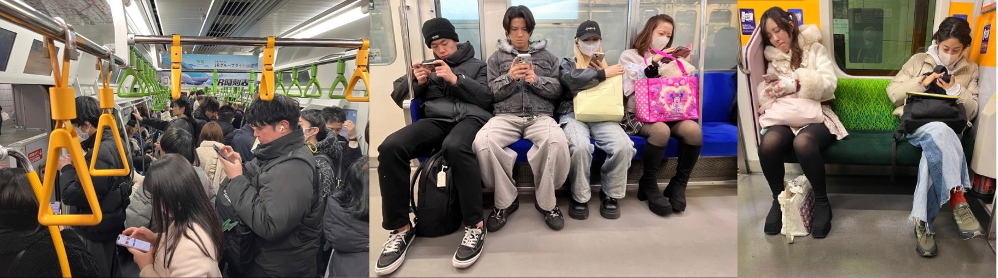
_ _ _ staying in Hiyoshi again, where the orihon sunset fatamorgana from the previous post is located, where the paths between places I’ve spent most of my time in Tokyo intersect . . . thus we repeat places, repetition again (repetition has to be – again)
_ _ _ today while entering the train on Tokyu-Toyoko Line (which averages 18 to 20 trains per hour in each direction, transporting over a million passengers per day) we came across a friend, a colleague whom we haven’t seen for at least a year; after the initial surprise, he asked where do we live now . . . to me, to us, answering that simple question is complex . . . indeed, where do I, where do we live? . . . who could understand the answer that in geographic terms our life is pendular, a truly nomadic space-time experience, that we can be precise only when the question where gets qualified, placed in a particular time . . . where do we live – when? when do we live – (t)here? . . . (in our architectural, urban parlance even the title of Kevin Lynch’s book “What time is this place?” has a lot to say about that)
_ _ _ thus, one could say that earlier today, on Tokyu Toyoko Line besides our dear colleague we have also met – albert Einstein
_ _ _ when answering where I am (from) I tend to hijack the question by adding when am I: when do I find myself thinking where am I (from), where I actually was from . . the complexity of possible answers, or of the possibly true answers, indeed demands that we enter the time/space, in order to address true complexity of a single, simple life (the life of mine, almost as complex as the parodic life of Monty Python’s Brian)
_ _ _ to me, in that (t)here is nothing less than Heidegger’s thrownness into the world; the incompatibility of Heidegger and Einstein only illustrates true complexity of this theme, the thinking of which demands more from both philosophy and science, as none of them alone will ever get the answers; cogito gets more complex with addition of sentio, sentio does get richer with cogito, but amo, the ultimate nuance of makes us human escapes them both . . . would Lefebvrian dialectics of triplicity help? . . . (since I’ve first heard of it, I loved Einstein’s emphasis on nothing less than elegance of his E=mc2 equation)
_ _ _ in any case, proper answers to the questions where am I from and where do I live demand placing those questions in time . . . we need the when
_ _ _ in order to avoid precision, I like to say that I am from the past . . . but, from the past – where am I? . . . as touched upon before, the house of my grandparents in(to) which I have been born stood in the same location yet in six or seven different countries; its garden, my grandfather Martin’s Park, as part of the orchards which have predated the house was situated in at least one more realm . . . thus, in some way I indeed am from (several) pasts . . . thrown into the World, into a particular World (which I loved and proudly was part of – as a particle of an impossible, improbable plural) I was thrown not into one, but into the flux of variously coexisting and conflicting culture(s), place(s), time(s) . . . one has to have courage of asking “stupid” questions (Andrei Linde) (as touched upon in my notes on the personal, thus subjective (in) research, post 036 On labyrinth, layers and masks)
_ _ _ to complicate the situation further, although factually born in that particular city, I was actually born in (at least) two cities . . . my first was birthplace was that of my physical birth, birth of my consciousness and early childhood; my second birthplace was that of my intellectual, cultural birth, the birth of my self-awareness . . . those two places intertwine(d), I coexist(ed) in them until one moment that felt as if they both died on me! I can still not be sure, but the story of my nomadism probably begins there (. . . that is not for discussion here)
_ _ _ to repeat the question asked before: am repeating myself? of course I do; we all do . . . repetitions shape us. . . repeated questioning, answering, bettering questions . . . we try, we fail, next time (we try to) fail better, precisely as Beckett has put it. . . repetitions form, at least they should form upwards spirals, flights which ask looking back, reaching back, the flights which demand (an awareness of) the foundations, deep down _ _ _ my places, my times, even my eras (the placed times which I feel as mine) . . . certain faces, certain places, certain times that make me think, that make my thought, facilitate the production of (my own) self
_ _ _ while teaching, particularly when presenting research within and around my pet course Theory and Practice of Urbanity, I present faces, places and times with an aim to establish the context for, and legitimise the origin and orientation of thinking and action that follow . . . these beginnings are about (re)visiting, (re)thinking times and, eventually, (re)making places and practices of (my) life, of my lives, lived, (until) there . . . that way I (hopelessly) seek new beginnings . . . the aim is self-discovery, self-definition, re-discovery, re-definition . . . that might explain declaration that I was born in two cities (intellectual re- birth as a continuing process, hopefully as long as one lives)
_ _ _ all that came up to me after bumping into a colleague and Albert Einstein at Tokyu Toyoko Line train earlier today . . .